Followers

Sunday, September 26, 2010

KERTAS PERCUBAAN 2010 (NEGERI)

PERCUBAAN NEGERI PERAK 2010 [DOWNLOAD] SKEMA [DOWNLOAD]

PERCUBAAN NEGERI JOHOR 2010 [DOWNLOAD]

PERCUBAAN NEGERI TERENGGANU 2010 [DOWNLOAD]

PERCUBAAN NEGERI KELANTAN 2010 [DOWNLOAD]

PERCUBAAN NEGERI SEMBILAN 2010 [DOWNLOAD]

PERCUBAAN NEGERI KEDAH 2010 [DOWNLOAD]

PERCUBAAN SBP 2010 [DOWNLOAD]

PERCUBAAN KUCHING 2010 [DOWNLOAD] 

PERCUBAAN NEGERI MELAKA 2010 [DOWNLOAD] 

PERCUBAAN NEGERI PERLIS 2010 [DOWNLOAD] 

PERCUBAAN NEGERI PAHANG 2010 [DOWNLOAD]

PERCUBAAN NEGERI SELANGOR 2010 [DOWNLOAD]

PERCUBAAN NEGERI MRSM 2010 [DOWNLOAD] [P1] [P2] [P3]  

Friday, September 24, 2010

SALTS PRESENTATION / DOWNLOAD NOTE


[DOWNLOAD] SALT NOTE

# THIS NOTE IS LINKED WITH JOM KIMIA A+ BLOG

Thursday, September 2, 2010

Tak Kenal Maka Tak Cinta. Season 1 Episode 4

SIZE OF ATOM 
 smallest particle of an element.
different ELEMENT - different size of atom.


ATOMIC SIZE, GOING DOWN THE GROUPS
(SIZE OF ATOMIC INCREASE)
 The number proton increase with number of electron increase are arranged in shell. The number of shells occupied with electrons increases when down the group elements. The size of atom increase.


ATOMIC SIZE, ACROSS THE PERIODS
(SIZE OF ATOMIC DECREASE)
All atoms in same period have the same number of shell(s) occupied with electrons. The proton number in nucleus increase by one unit from element to next element across period. Positive charge in the nucleus increase causing nuclei attraction force strong. The electrons shell are pulled closer to the nucleus. The size of atom decrease.

SIZE OF ION

Size of positive charged ion (CATION) are smaller than their neutral atom. WHY ? Number of proton is more than number of electron in cation. The POSITIVE CHARGE of the nucleus INCREASES. The FORCE OF ATTRACTION of nucleus on the electrons INCREASES. The electrons shell are pulled closer to the nucleus. Ionic size become smaller.


Size of negative charged ion are larger than their neutral atom. By adding electron to a neutral atom, then formed ANION. Number of electron increase causes repulsions(tolakan) between electron. The force of attraction of nucleus on the electrons weaker and electron move further apart. The ionic size become larger.

Wednesday, September 1, 2010

EXERCISE : CALCULATION

TOPIK :

7.1 ACIDS AND BASES

Sunday, December 20, 2009

Tak Kenal Maka Tak Cinta. Season 1 Episode 3 (2009)

Siapa yang cipta ATOM? - Dah tentulah YANG MAHA PENCIPTA...

History of the developement of atomic models.[Rujukan untuk KBSM (ICSS)]

SCIENTIST ATOMIC MODEL BEGIN...


NEXT


NEXT


NEXT


NEXT


SOURCE : Think Quest

Friday, November 27, 2009

Tak Kenal Maka Tak Cinta. Season 1 Episode 2 (2009)

ZARAH DALAM ATOM (SUBATOM)

Subparticles of atom (Subatomic particles)


  1. Ordinary matter consists of atoms bound together by electromagnetic force to form molecules. These molecules come together to form solids, liquids and gasses.
  2. Atoms consist of a dense nucleus surrounded by a cloud of electrons. Electromagnetic force holds the nucleus and electrons together.
  3. The nucleus consists of protons and neutrons held together by a powerful nuclear force.
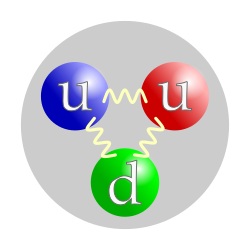
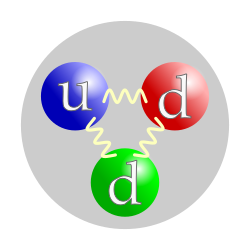
  4. Protons and neutrons consist of three quarks each and are held together by powerful nuclear force.
Source : Sub-atomic particles in Qur'an

SECARA UMUM
Atom terdiri daripada 3 subatom yang "terkenal" dan dikenali sebagai proton, neutron dan elektron.
Atom is made up from three subparticles that is protons, neutrons and electrons.

PROTON


The proton is a subatomic particle with an electric charge of +1 elementary charge. It is found in the nucleus of each atom, along with neutrons, but is also stable by itself and has a second identity as the hydrogen ion, H+. It is composed of three fundamental particles: two up quarks and one down quark


ELECTRON
The electron is a fundamental subatomic particle that carries a negative electric charge. Together with atomic nuclei, which consist of protons and neutrons, electrons make up atoms. Electron move around atomic nuclei. Their interaction with adjacent nuclei is the main cause of chemical bonding.


NEUTRON

The neutron is a subatomic particle with no net electric charge and a mass slightly larger than that of a proton. Neutrons are usually found in atomic nuclei. It is composed of three fundamental particles: one up quarks and two down quark.